
If you’ve ever been told your car has “structural damage,” you probably nodded and hoped it wasn’t as bad as it sounded. It’s a scary phrase. But what it actually means depends a lot on how your car is built, and most cars on the road today are built very differently from the ones your parents drove.
Two ways to build a vehicle
Older cars and many trucks use body-on-frame construction. There’s a strong steel frame, a bit like a ladder, and the body gets bolted on top. The frame carries the weight and takes the hit in a crash.
Most modern cars, crossovers, and SUVs are unibody. There’s no separate frame. The floor, roof pillars, rails, and body panels are welded together into one structure, and the whole thing works as the skeleton. It’s lighter, which helps fuel economy, and it handles better. It also lets engineers design the front and rear to crumple in a planned way, so the crash energy gets absorbed before it reaches you.
Why that matters after a collision
On a body-on-frame vehicle, a bent frame can often be pulled back into shape on a frame machine. It’s still skilled work, but the frame is one clear piece.
A unibody is trickier. Damage in one spot travels. A hit to the front corner can push a force through the rails and into the floor or the door openings, and you might not see anything wrong until you check how the doors close or notice the car tracking a little off. That’s why a small dent can sit on top of a bigger problem. Our article on spotting hidden damage after a car accident goes through some of the signs.
It’s all about the measurements
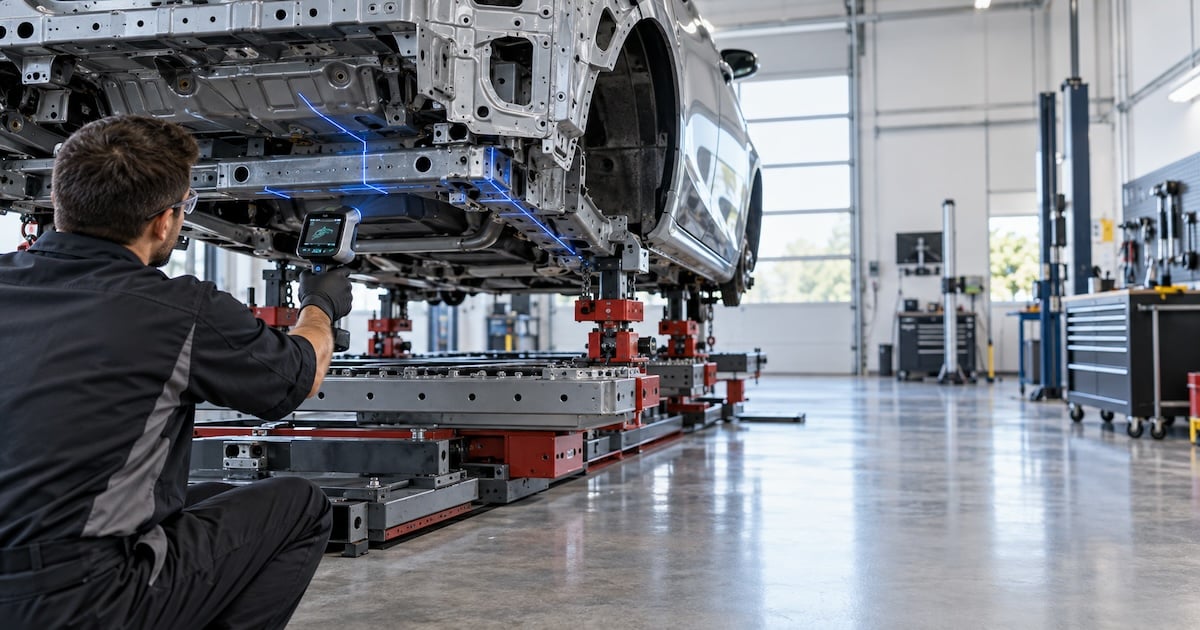
Your car’s structure has specific dimensions, set by the manufacturer, and they’re tight. A sagging rail or a twisted pillar can be off by a few millimeters and you’d never catch it by eye. So structural repair starts with computerized measuring. The system checks dozens of points on the underbody and compares them to factory specs, then guides the technician as the vehicle is pulled back on the frame rack.
Those same measurements get checked again when the work is done. If the numbers match, the car sits and drives the way it was designed to. If they don’t, you can end up with uneven tire wear, wind noise, doors that don’t seal, and a car that doesn’t protect you the way it should in the next crash.
Modern steel has rules
This part surprises people. Today’s unibody cars use a mix of steels, including high strength types that are tougher than the old stuff. They’re great at protecting you, but they don’t take kindly to shortcuts. Many of them can’t be heated to straighten them the way older steel could, because heat changes how the metal behaves in a crash. Some parts have to be replaced, not repaired, and cutting and welding has to follow the manufacturer’s procedure exactly.
That’s why sticking to factory repair procedures matters so much, and why the right equipment and training make a real difference. We explain more about this in how technology transforms auto collision repairs.
What to ask your shop
A few simple questions can tell you a lot:
- Will my car be measured before and after the repair?
- Do you follow the manufacturer’s repair procedures?
- What training and certifications does your team have?
- Will the repair include a check of the safety systems when it’s finished?
If a shop can’t answer these clearly, keep looking. You can also read our post on why post-repair inspections are crucial for your safety to see what a thorough final check should include.
Worried about structural damage?
If you’ve been in a collision, even a moderate one, and something feels a little off, let us take a look. Our certified technicians use computerized measuring to find out exactly what’s going on underneath, and we’ll walk you through it in plain language. Learn more about our collision repair services, then call one of our Oklahoma City or Midwest City locations to set up an estimate. We’ll tell you what your car needs, and just as importantly, what it doesn’t.